

Predictive forecasting helps high-ticket businesses improve marketing by using historical data and customer behavior to predict demand. This approach allows companies to allocate resources efficiently, time campaigns better, and avoid costly mistakes during low-demand periods. The article discusses three methods:
- Statistical Forecasting: Relies on data trends and mathematical models like time series analysis and regression. Works best with clean, consistent data but struggles with complex or fast-changing markets.
- Machine Learning: Uses adaptive algorithms like neural networks to handle large datasets and uncover patterns. Offers higher accuracy but requires extensive data, technical expertise, and higher costs.
- Clearnet Marketing: Provides AI-driven tools tailored for high-ticket businesses, combining advanced forecasting with marketing automation for personalized customer engagement.
Each method serves different needs, with Clearnet Marketing offering a specialized solution for businesses seeking precise, scalable strategies.
How Predictive Analytics and Generative AI Help You Forecast and Plan Your Future Marketing Success
1. Traditional Statistical Forecasting
For decades, traditional statistical forecasting has been a cornerstone of business planning. It relies on mathematical models to analyze historical data and predict future trends. In marketing operations, common approaches include time series analysis, regression models, and moving averages to anticipate demand patterns and customer behavior.
Forecasting Approach
These methods focus on identifying data trends through mathematical formulas:
- Time series analysis examines data collected at consistent intervals to uncover seasonal trends, cyclical patterns, and long-term growth. For example, analyzing three to five years of monthly sales data can highlight peak and off-peak periods, helping businesses plan accordingly.
- Regression analysis explores relationships between variables. A luxury real estate company, for instance, might use this method to understand how factors like interest rates, local economic trends, and seasonal shifts influence lead generation and conversion rates. This analysis helps predict how changes in these variables might impact future marketing outcomes.
- Moving averages smooth out short-term fluctuations to reveal broader trends. This technique is especially helpful for businesses with irregular sales cycles, as it can distinguish between temporary spikes or dips and genuine long-term changes.
The success of these methods hinges on having reliable and consistent data.
Data Requirements
For accurate predictions, businesses need at least two to three years of clean, consistent data. This data must be collected at regular intervals and formatted uniformly to ensure precise analysis. Key metrics often include lead generation, conversion rates, acquisition costs, and segmented revenue.
However, incomplete or inconsistent data can lead to skewed results. Many businesses encounter gaps in their historical records when they first adopt statistical forecasting, requiring significant time and effort to clean and organize their data before achieving reliable results.
Business Integration
Once the data is prepared, integrating statistical forecasts into daily operations is essential. Businesses typically establish regular reporting cycles, such as monthly or quarterly reviews, where marketing teams compare forecasts to actual performance. Based on these comparisons, teams can adjust advertising budgets, tweak campaign strategies, or time product launches to align with predicted demand.
To make the most of these forecasts, marketing staff often need training to interpret statistical outputs and translate them into actionable strategies. For example, a team might use forecasted trends to allocate resources toward high-demand periods or scale back during slower seasons.
That said, traditional models have limitations, particularly when it comes to the fast-paced nature of digital marketing. Businesses often need to pair these forecasts with real-time monitoring to stay agile.
Growth and Maintenance
As businesses scale, their forecasting models must adapt to account for new market segments, products, and customer behaviors. Regular updates and refinements are critical to keeping predictions accurate. This involves validating models by comparing forecasts to actual outcomes and identifying any discrepancies or "drift" in accuracy.
Most companies update their models quarterly or semi-annually, incorporating fresh data and tweaking parameters based on performance insights. While traditional methods have modest computational demands, they do require manual updates and skilled expertise, which can slow down scalability for some organizations.
Despite these challenges, traditional statistical forecasting remains a reliable and accessible tool for businesses, particularly those with limited technical resources. By maintaining and refining these models, companies can continue to make informed, data-driven decisions.
2. Machine Learning-Based Forecasting
Machine learning-based forecasting takes traditional statistical methods and gives them a modern twist. Instead of sticking to fixed mathematical formulas, these systems learn from data patterns and adjust their predictions over time. This dynamic approach builds on traditional methods but evolves as new data comes in. For businesses dealing with high-value transactions, this means better predictions for customer behavior, demand changes, and market trends.
Forecasting Approach
Machine learning models rely on algorithms that adapt and improve as they process more data. Unlike traditional methods that follow rigid rules, these systems can uncover complex patterns.
- Neural networks are particularly effective at handling multiple variables at once. For example, a luxury car dealership might combine data on demographics, browsing habits, and economic trends to predict which customers are most likely to make a purchase.
- Random forest algorithms use a collection of decision trees to make predictions, which reduces the risk of relying on a single model. This is especially useful for identifying diverse buying behaviors across different customer groups.
- Support vector machines help define clear boundaries between customer segments. This can be a game-changer for businesses trying to identify high-value leads versus casual inquiries.
Data Requirements
Machine learning thrives on diverse, high-quality data. While traditional forecasting often relies on historical sales data, machine learning models can incorporate a broader range of inputs. Key data sources include:
- Customer interaction logs
- Website analytics
- Social media engagement
- Email response rates
- External factors like economic trends or industry news
The more varied the data, the stronger the model’s predictions. However, these models require large volumes of data – often spanning years of customer interactions – to deliver accurate results. Ensuring data quality is critical, which involves cleaning the data to standardize formats, remove duplicates, and address missing values.
Business Integration
Integrating machine learning into existing systems can simplify decision-making processes. These models often connect directly to tools like customer relationship management (CRM) platforms, marketing automation software, and advertising networks.
For example, instead of having marketing teams manually review leads and assign scores, machine learning models can quickly evaluate prospects and trigger follow-up actions. They can also forecast which marketing channels will perform best at specific times, allowing businesses to adjust ad spending in real time.
Staff training plays a crucial role in this integration. Teams need to understand how to interpret model outputs, such as confidence scores, and know when adjustments are necessary. This allows employees to focus on strategic, creative tasks while the algorithms handle data-heavy pattern recognition.
A/B testing is another valuable tool for refining these models. By comparing predictions with actual outcomes, businesses can gather insights to improve accuracy over time.
Growth and Maintenance
Machine learning models evolve alongside a business, but they require ongoing oversight to stay accurate. Unlike static traditional models, machine learning systems adapt to changes in customer behavior and market conditions.
To maintain performance, businesses should monitor for "model drift", which happens when predictions become less reliable as data patterns shift. Many systems include automated alerts to notify teams when prediction quality drops.
As operations grow and data becomes more complex, businesses may need scalable, cloud-based solutions for processing. Version control is also essential – if a model update reduces accuracy, companies should be able to quickly revert to an earlier version while resolving the issue.
Regular audits are a must. Comparing prediction accuracy across different customer segments, time periods, and market conditions helps ensure the model stays sharp. Over time, the investment in refining these models pays off through better predictions and more efficient, automated decision-making.
Next, we’ll explore how Clearnet Marketing puts these techniques to work for high-ticket businesses.
sbb-itb-9228db7
3. Clearnet Marketing
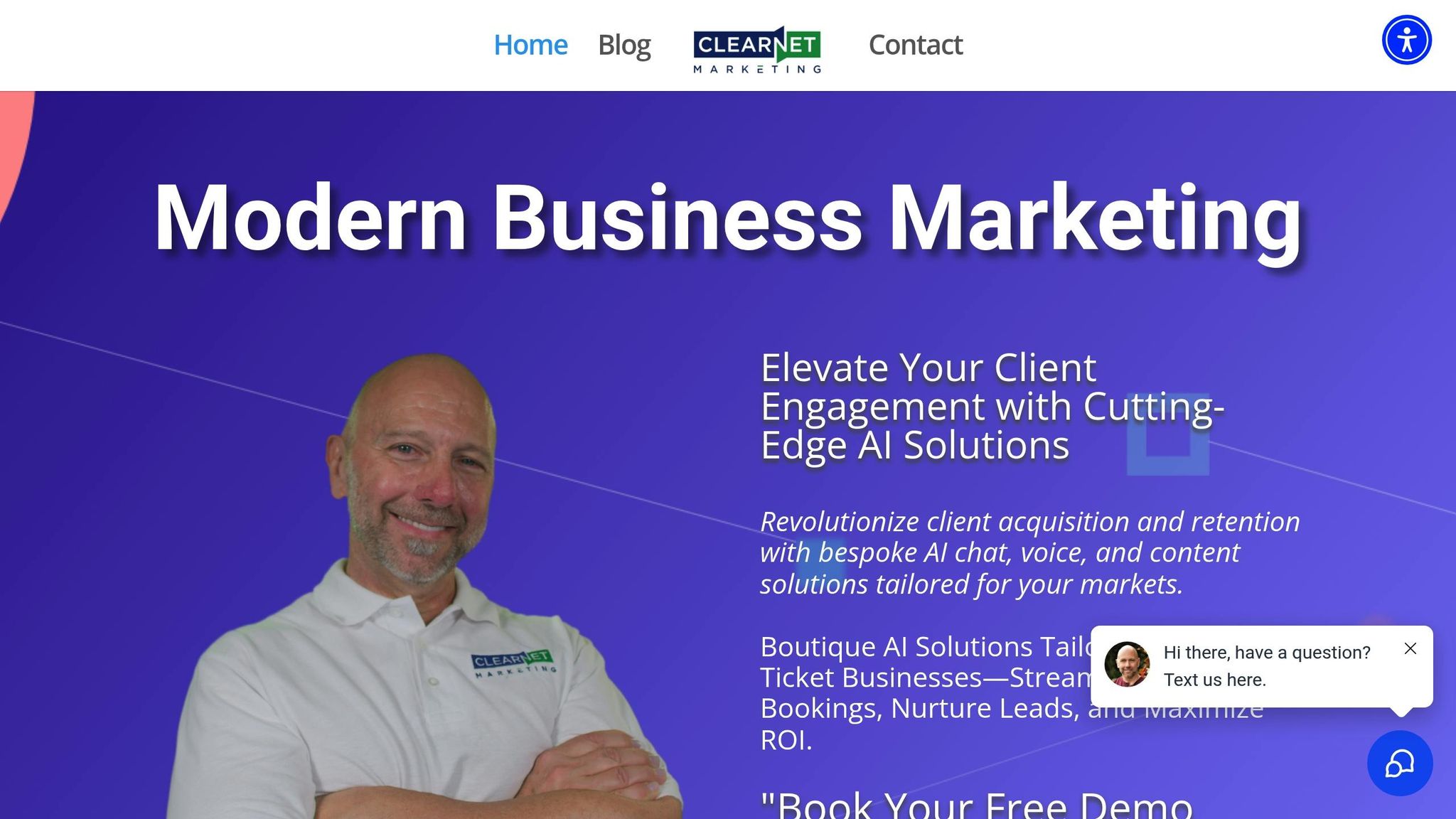
Clearnet Marketing takes the latest advancements in forecasting and uses them to deliver cutting-edge AI-driven marketing solutions tailored for high-ticket businesses.
Their platform offers tools like AI-powered chat, voice, and content automation to simplify lead nurturing, streamline bookings, and boost client engagement. These tools work together to save time and improve efficiency, allowing businesses to focus on what matters most – building strong client relationships.
Although the specifics of their forecasting methods are proprietary, Clearnet Marketing ensures seamless integration with existing workflows. By leveraging data-driven insights, the platform helps businesses implement scalable and customized strategies to stay ahead of market trends.
A key focus for Clearnet Marketing is creating personalized customer experiences. By tailoring their approach, they help businesses not only attract new clients but also retain existing ones. Their evolving solutions are designed to adapt to market shifts, giving high-ticket businesses the tools they need to enhance marketing performance and achieve consistent growth.
Advantages and Disadvantages
Let’s dive into the strengths and limitations of different forecasting methods. Each approach brings its own set of benefits and challenges, making them suitable for varying scenarios. Below is a table summarizing these trade-offs, followed by a deeper look at key factors.
| Approach | Advantages | Disadvantages |
|---|---|---|
| Traditional Statistical Forecasting | • Easy to understand and implement • Minimal computational needs • Affordable for small datasets • Quick to set up and use • Results are straightforward to interpret |
• Limited accuracy with complex data patterns • Struggles with non-linear relationships • Requires manual tuning of parameters • Inefficient for large datasets • Poor adaptability to fast-changing markets |
| Machine Learning-Based Forecasting | • Handles complex datasets with high accuracy • Automatically identifies patterns • Efficiently works with large datasets • Adapts to shifting market conditions • Analyzes multiple variables simultaneously |
• Demands advanced technical expertise • High setup and maintenance costs • Results can be hard to interpret ("black box" issue) • Needs extensive historical data • Time-consuming to train models |
| Clearnet Marketing | • Integrates easily with current workflows • Tailored for high-ticket business needs • Scalable for personalized customer engagement • Custom strategies for client acquisition and retention |
None |
Beyond these specifics, broader considerations like cost, scalability, transparency, and time-to-value play a significant role in determining the best approach.
Cost and Scalability
For businesses seeking cost-effective solutions, traditional statistical methods are a natural choice. They’re affordable upfront but often require ongoing manual adjustments, which can add to long-term effort. On the other hand, machine learning demands a larger initial investment but offers significant accuracy gains and efficiency over time. Clearnet Marketing strikes a balance by delivering scalable solutions tailored for industries with high-value transactions, all while reducing the need for in-house technical expertise.
Complexity and Adaptability
Traditional methods are well-suited for smaller operations or straightforward forecasting needs but fall short when dealing with intricate data patterns. Machine learning shines here, excelling at processing massive datasets and uncovering subtle trends. This makes it a strong choice for businesses experiencing rapid growth or handling complex customer journeys.
Transparency and Decision-Making
Transparency is another critical factor. Traditional models are easy to interpret, which is valuable in regulated industries or when justifying decisions to stakeholders. Machine learning, while more accurate, often lacks this transparency due to its "black box" nature, which can be a drawback in certain scenarios.
Time to Value
The time required to see results also varies. Traditional methods can be deployed quickly, delivering immediate insights even if they’re less advanced. Machine learning, however, requires months of development and testing before it starts to deliver meaningful outcomes. Clearnet Marketing offers a middle ground, with its tools designed for rapid implementation, allowing businesses to quickly leverage AI-driven marketing insights.
Ultimately, choosing the right approach depends on a company’s current needs and future goals. Smaller businesses with limited technical resources might stick with traditional methods, while those aiming for growth and dealing with complex challenges will benefit more from machine learning or specialized platforms like Clearnet Marketing. These solutions are particularly powerful for high-ticket industries, combining advanced analytics with practical marketing automation to support both immediate and long-term success.
Conclusion
Choosing the right forecasting method – whether traditional statistical models, machine learning tools, or specialized platforms – depends on where your high-ticket business currently stands and its future goals. Each approach fulfills distinct needs, but the demand for scalability and the complexity of customer journeys in high-value industries often lean toward more advanced solutions.
Traditional methods work well for simpler, early-stage forecasting but quickly hit their limits as businesses grow and require more nuanced, personalized insights. These methods simply can’t keep up with the demands of scaling operations.
Machine learning-based forecasting, on the other hand, provides the analytical depth needed for complex scenarios. However, it often comes with challenges: lengthy development timelines, high technical expertise requirements, and steep implementation costs. For high-ticket businesses needing quick, actionable insights, these hurdles can become significant roadblocks.
This is where a more tailored solution shines. Clearnet Marketing stands out as a practical choice for high-ticket businesses aiming to scale efficiently. By blending machine learning capabilities with rapid deployment, it addresses the need for personalized engagement through features like AI-driven chat, voice automation, and content systems. These tools are designed specifically for the unique demands of high-value transactions.
For businesses generating substantial revenue per customer, platforms like Clearnet Marketing deliver a strong return on investment. Enhanced lead nurturing and improved conversion rates make it a strategic choice. Its customized approach ensures that forecasting integrates seamlessly with existing business processes, avoiding the need for businesses to conform to generic tools.
Ultimately, the decision comes down to your growth goals and available resources. If immediate results and scalable operations are key priorities, and you’d rather focus on scaling than building in-house AI capabilities, specialized platforms offer the quickest route to advanced predictive forecasting. With features tailored to industry needs and ongoing optimization, they provide high-ticket businesses the tools to scale their marketing strategies effectively. Accurate and sophisticated forecasting remains a cornerstone of success in this space.
FAQs
How can businesses ensure they have the right data quality and enough volume for accurate predictive forecasting?
To get accurate results from predictive forecasting, businesses need to focus on gathering high-quality, relevant data. This means identifying key data points that matter most, while also ensuring the information is clean, precise, and regularly updated. Using standardized data formats and leveraging automated tools for validation and monitoring can go a long way in keeping data consistent and reliable across different sources.
Another crucial factor is having a large enough volume of data to produce dependable insights. Investing in tools and systems that simplify data collection and management can make a big difference, especially when dealing with high-stakes marketing strategies. By sticking to strong data management practices, companies can tap into the full potential of predictive forecasting to grow their operations with confidence.
What should businesses consider when implementing predictive forecasting into their marketing systems?
When bringing predictive forecasting into your marketing systems, there are a few areas you’ll want to prioritize. First, make sure you have reliable and detailed historical data – this is the backbone of any accurate prediction. Adding external elements like market trends or shifts in the economy can also make your forecasts more precise.
Next, tackle common obstacles like data silos or the lack of real-time information by implementing solid data management strategies. It’s also a good idea to select machine learning models that can adjust as market conditions change, so your predictions stay useful and up-to-date.
Lastly, keep a close eye on your forecasting systems and tweak them as needed. This kind of ongoing attention helps you adapt to demand changes and scale your marketing efforts with confidence and efficiency.
What makes Clearnet Marketing’s strategies unique for scaling high-ticket businesses?
Clearnet Marketing sets itself apart by using AI-driven tools to craft scalable and personalized marketing strategies specifically designed for high-ticket businesses. Their approach streamlines critical processes such as lead nurturing, client engagement, and booking management, ensuring a smooth and efficient experience for customers at every touchpoint.
By blending smart automation with tailored strategies, Clearnet Marketing enables businesses to provide highly customized experiences on a larger scale. This makes it simpler to attract, convert, and retain high-value clients effectively.