
B2B marketing automation simplifies repetitive tasks, enabling businesses to deliver personalized, data-driven experiences at scale. It’s critical for managing complex sales cycles, nurturing leads, and improving efficiency. Companies using automation report increased qualified leads (451%), higher sales productivity (14.5%), and lower marketing costs (12.2%). With AI tools, automation now offers predictive analytics, real-time personalization, and dynamic workflows, helping businesses better engage prospects and drive revenue growth.
Key Takeaways:
- Define clear goals and metrics (e.g., MRR, CAC, lead conversion rates).
- Assess current processes and data quality before implementation.
- Invest in AI-powered platforms with features like email marketing, lead scoring, and multichannel campaigns.
- Align sales and marketing teams with shared data, lead scoring systems, and SLAs.
- Continuously track performance, optimize workflows, and document learnings.
Automation is no longer optional but a necessity for staying competitive in today’s B2B landscape.
B2B Marketing Automation Hacks You Can’t Afford To Miss
Assessing Business Readiness for Automation
Taking the time to assess your readiness for automation can save you from costly mistakes and ensure your efforts deliver measurable results. Diving in without proper preparation often leads to poor data handling, unclear goals, and wasted resources.
Successful automation rests on three key pillars: clear objectives with measurable metrics, a thorough understanding of your current processes, and clean, well-integrated data systems. These elements form the backbone of any effective automation strategy. Start by defining your KPIs and aligning them with your business goals.
Define Objectives and Key Metrics
To justify your investment and track progress, you need specific, measurable goals. A Gartner study found that B2B buyers spend more time educating themselves online about potential purchases than engaging directly with suppliers. This shift highlights the importance of automation in supporting buyers throughout their extended research journey.
Using SMART goals (Specific, Measurable, Achievable, Relevant, Time-bound) can provide structure to your automation strategy. These goals should tie directly to broader business objectives and focus on actionable insights for improvement.
For instance, InnoGen AI set clear objectives around KPIs such as Monthly Recurring Revenue (MRR) growth, churn reduction, lead conversion rates, and Customer Acquisition Cost (CAC) optimization. These metrics helped refine their sales processes and improve efficiency.
When selecting KPIs, aim for a balance between leading indicators (predicting future performance) and lagging indicators (reflecting past results). With B2B companies allocating an average of 9.7% of their budgets to marketing, ensuring these metrics deliver a return on investment is critical.
| Category | KPI Examples |
|---|---|
| Revenue Growth | MRR, Customer Lifetime Value, Average Deal Size |
| Lead Generation | Marketing Qualified Leads, Cost Per Lead |
| Conversion Rates | Lead-to-Customer Rate, Email Click-Through Rate |
| Customer Retention | Churn Rate, Customer Satisfaction Score |
| Efficiency Metrics | CAC, Sales Cycle Length, Marketing ROI |
Regularly review and refine your KPIs as your business evolves. Tools like HubSpot, Google Analytics, or SEMrush can automate tracking, making it easier to focus on what matters most.
Evaluate Current Sales and Marketing Processes
A thorough evaluation of your existing workflows can uncover inefficiencies, gaps, and areas for improvement. Mapping your buyer journey is a good starting point – it helps pinpoint where prospects drop off or accelerate, from initial contact to expansion.
Analyze the effectiveness of your current content. Are you reaching prospects at every stage of their buying journey? With 40% of B2B buyers using social media as part of their research process, your evaluation should cover all digital touchpoints.
Tracking customer interactions and engagement can reveal patterns in audience behavior. This insight allows you to tailor your automation strategies to meet specific customer needs. Look closely at conversion rates across the funnel to identify problem areas.
"Look at your data, figure out what it’s telling you from a very high level, and then, from there, build your roadmap." – Chris Gordon, Head of Client Success, Noticed
Incorporate A/B testing into your process. Testing different versions of emails, landing pages, and ads can show you what resonates best with your audience. Assign tools and tactics to each stage of the buyer journey to identify overlaps, gaps, or misaligned activities that automation can address.
Ensure alignment between sales, marketing, and customer success teams. This collaboration is essential for a seamless evaluation and implementation process. Additionally, analyze your lead scoring, nurturing sequences, and handoff processes to determine which workflows are ready for automation and which need adjustments.
Check Data Quality and CRM Integration
Once workflows are mapped, focus on the quality and integration of your data systems. Poor data can derail automation efforts, and IBM estimates this issue costs U.S. businesses $3.1 trillion annually. Clean, well-integrated data is the foundation for effective AI personalization and precise automation.
Data quality involves six dimensions: accuracy, completeness, uniqueness, consistency, relevance, and timeliness. Your CRM data plays a crucial role in targeted lead generation, personalized engagement, market segmentation, and predictive analytics.
"Good data is data that delivers value. So, I think whichever data set you’re looking at, if it’s not returning some sort of value, then you have to question why you’re keeping it." – Connel Bell, Altrata COO
Ensuring seamless integration between your CRM and other systems reduces manual errors and maintains data consistency. Before implementing automation, set clear data entry protocols to minimize mistakes. Regular audits and data cleansing should be part of your routine, ideally conducted quarterly, to maintain data integrity.
Assign team members as data owners for specific fields to ensure accountability. Consider data enrichment to fill in missing details and improve the completeness of your CRM information. Monitor metrics like data completeness rates and duplication levels to track progress.
The benefits of clean, integrated data are significant. Companies that incorporate automation into their marketing strategies report a 53% increase in conversion rates. CRM systems deliver an average ROI of $8.71 for every dollar spent and can boost sales revenue by up to 29%.
"You need clear processes to maintain data quality proactively, not just fix problems as they arise." – Martin Wise, RelPro CEO
Nearly 74% of companies report improved access to customer data through CRM systems. When paired with clean, integrated data, this access can significantly enhance the effectiveness of your automation platform. Promote data quality through regular training, clear communication, and accountability across your team. A commitment to these practices ensures your automation efforts remain efficient as they scale.
Selecting AI-Powered Marketing Platforms
Choosing an AI-powered marketing platform that can grow with your business is essential, especially as 91% of marketing decision-makers expect automation demands to rise by 2025. The right platform should offer powerful features, be easy to use, and integrate seamlessly with your existing systems.
Your decision should align with your business goals and industry needs. Companies using AI-driven marketing automation report an average 20% increase in sales and a 15% reduction in marketing expenses. However, these benefits depend on selecting tools tailored to your unique situation. Below, we’ll dive into the must-have features and compatibility factors that make AI-powered marketing platforms effective.
Key Features to Consider
Start by pinpointing the core functionalities your business needs. Essential features include lead generation, campaign management, and robust analytics. Beyond these basics, look for tools that support:
- Email marketing
- Multichannel campaigns
- Social media management
- Landing pages and forms
- Personalized campaigns
- Workflow automation
The platform’s usability is just as critical as its features. A user-friendly interface with minimal learning curve and solid customer support ensures your team can adopt the tool effectively. Even the most advanced features are wasted if your team struggles to use them.
AI tools can also enhance every stage of your marketing funnel:
| Funnel Stage | AI Tools That Add Value |
|---|---|
| Awareness | Jasper (content), Opal (orchestration), 6sense (intent) |
| Consideration | Drift (engagement), Opal (journey testing), 6sense (predictive) |
| Decision | Mutiny (personalization), Einstein (scoring), Drift (chat) |
| Reporting/Ops | Salesforce Einstein, Opal analytics, 6sense insights |
Customizable workflows are another key consideration. Your platform should adapt to your business processes, not the other way around. For example, 75% of companies using AI-powered automation report increased efficiency, showing the value of tailored workflows.
"AI is the next step in business automation. AI has been instrumental in improving business processes. AI can be deployed to an organization’s business process for a particular strategic purpose to increase efficiencies, cut costs, and improve customer service." – Jasper AI
Pricing varies widely depending on features, team size, and data volume. Some platforms charge per user, while others base pricing on data usage or system activity. Be sure to evaluate your needs to find a cost-effective option.
Platform Compatibility Requirements
Integration capabilities are crucial for successful automation. Choose AI platforms with strong API support to ensure compatibility with your current tech stack. Poor integration can lead to longer implementation times, higher costs, and reliance on technical experts to bridge system gaps.
Check for compatibility issues early to avoid delays. Data standardization is often necessary when integrating AI tools with older systems. For example, you may need to convert older data formats into modern ones like JSON or XML. If APIs are unavailable, custom connectors or middleware solutions can facilitate data exchange.
Mapping and normalizing your data structures can prevent major headaches during implementation. Integration platforms can also help connect AI tools with legacy systems. A gradual integration process works best – start with critical marketing areas to minimize disruptions and test compatibility before expanding.
Additionally, ensure your platform complies with U.S. data privacy regulations, especially if your business handles sensitive customer or B2B information. Adequate security measures are non-negotiable.
Clearnet Marketing: A Tailored Solution
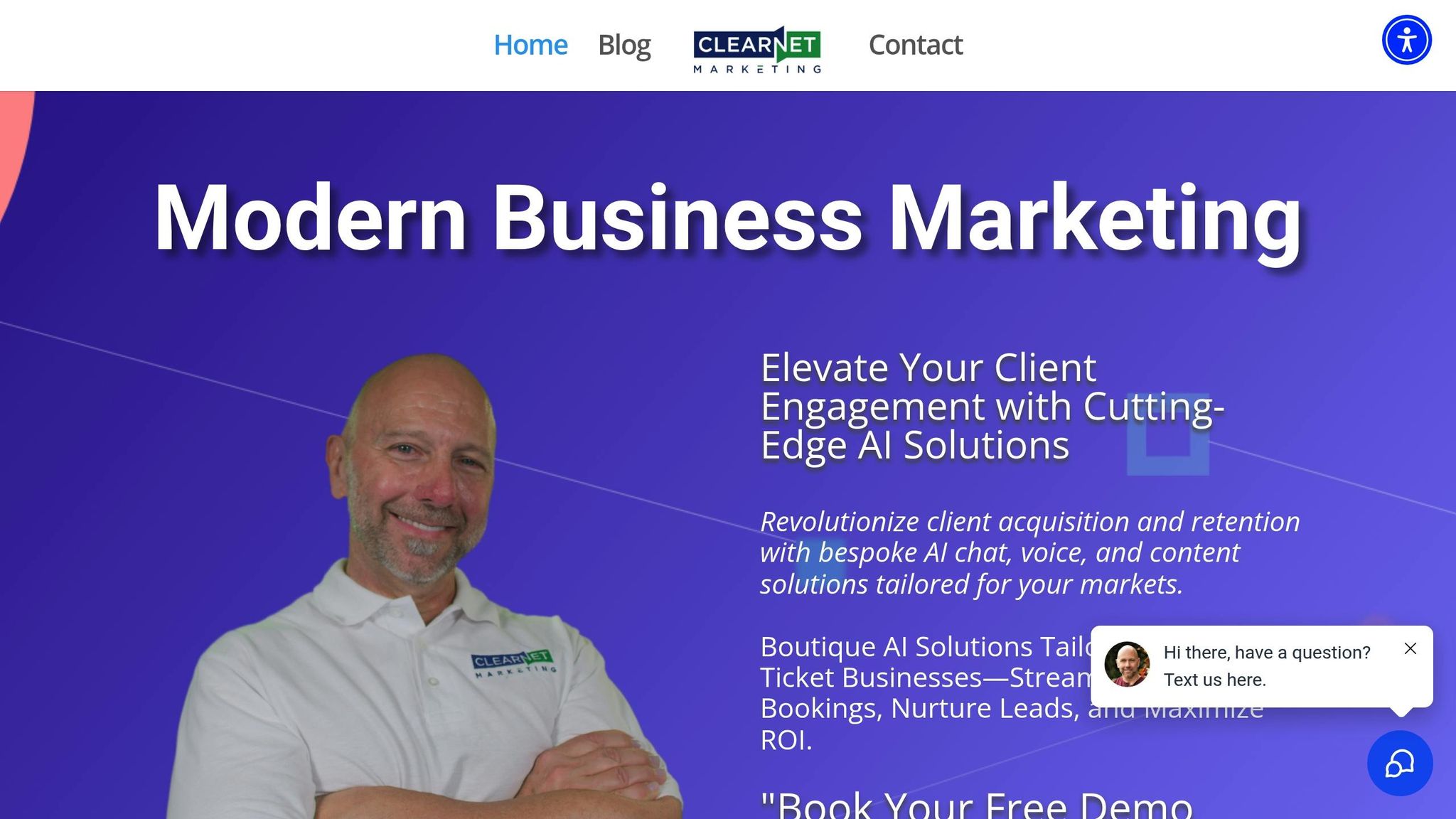
Clearnet Marketing offers a tailored AI-powered platform designed to meet the demands of high-ticket B2B industries. Its suite of tools includes intelligent AI chat, voice automation, and content automation, creating a seamless experience for businesses and prospects alike.
The platform’s AI chat feature handles initial prospect interactions, qualifying leads while maintaining a personal touch. This is especially important in high-ticket industries where prospects expect immediate, detailed responses. Voice automation ensures consistent messaging across phone interactions, further enhancing the customer experience.
Clearnet’s content automation goes beyond simple email sequences. By using prospect behavior, industry insights, and buying journey stages, the platform generates highly personalized content. This helps businesses maintain a boutique feel while scaling their marketing efforts.
The platform is also built for the longer sales cycles typical of high-ticket B2B industries. Instead of focusing on quick conversions, it emphasizes relationship-building and delivering value over time – an approach well-suited to complex enterprise sales.
Clearnet Marketing offers three pricing tiers – Basic, Professional, and Enterprise – each customized to fit specific business needs. The Enterprise tier provides access to the full suite of AI tools, custom strategies, and advanced client engagement features.
With its scalable architecture, Clearnet adapts as your business grows. By focusing on personalized strategies and operational efficiency, it’s a strong choice for businesses prioritizing client relationships. In fact, 62% of companies report that AI has significantly improved customer service through enhanced personalization, making platforms like Clearnet invaluable for businesses aiming to balance efficiency with a personal touch.
Building Automated Workflows for Personalization
Once you’ve chosen an AI-powered platform, the next step is creating workflows that scale personalized experiences. These workflows should intelligently segment audiences, deliver tailored messages, and coordinate across multiple channels to guide prospects through complex B2B buying journeys. This builds on earlier strategies of selecting and integrating the right AI tools.
Create Segmented Workflows
Start by segmenting your audience based on factors like industry, company size, and behavior patterns. This segmentation allows for more targeted communication that aligns with the specific needs of each group. For instance, a cybersecurity company might group prospects into categories such as healthcare (focusing on HIPAA compliance), financial services (emphasizing fraud prevention), and manufacturing (highlighting operational security).
To ensure success, align your automation strategy with clear business goals and revenue targets. Map workflows to key metrics, such as email open rates or sales-qualified leads. A great example comes from McAfee, which used advanced audience segmentation to deliver targeted content at critical stages of the buying process. This approach resulted in quadrupled conversion rates, better lead quality, improved sales and marketing alignment, and more efficient content delivery.
Regularly analyzing performance metrics can also help you identify which segments drive the best results, allowing you to allocate resources more effectively.
Use AI for Personalized Messaging
AI takes personalization to another level by analyzing user behavior in real time. It can adjust email subject lines, timing, and content based on past interactions. According to a McKinsey report, 89% of leading businesses are already investing in AI to boost revenue growth, and by 2025, 35% of content creation companies plan to use generative AI for their work.
AI can track signals like website visits, email opens, and content downloads to rank and prioritize prospects automatically. For example, if someone downloads multiple whitepapers on compliance automation, your AI system could trigger content tailored to regulatory challenges in their industry.
AI also enables dynamic website experiences, where content adapts to the visitor’s profile. Chatbots powered by AI can initiate conversations based on user actions, such as discussing ROI or outlining next steps. These bots analyze behavior patterns to provide timely, relevant responses.
"AI in marketing is like protein powder in nutrition – it’s a powerful supplement, not a magic fix. It helps scale what already works, making strong strategies even stronger, but it won’t turn bad marketing into good marketing." – Jamie Pagan, Director of Brand & Content
For account-based marketing (ABM), AI can personalize outreach strategies. It helps tailor ad creatives, website content, and sales interactions to meet the unique needs of each account.
"AI can already support in a wide range of areas when it comes to ABM. From hyper-personalization, copywriting and testing, to behavioral & engagement-based scoring – all of these use-cases can already be enhanced and brought to the next level with the help of AI-tools." – Patrick Schuller, Paid Social Manager
Set Up Multi-Channel Automation
After establishing segmented workflows and AI-driven messaging, expand your strategy with multi-channel automation. This approach ensures consistent communication, improves follow-ups, and engages prospects at the right moments. By 2025, digital channels are expected to account for 80% of all B2B sales engagements.
Identify the channels your prospects use most – such as email, SMS, Google and social media ads, live chat, and chatbots – and set clear goals for each one. For example:
- Hot leads might receive immediate outreach via phone and email.
- Warm leads could enter email nurture sequences paired with LinkedIn engagement.
- Cold leads may see retargeting ads and periodic check-ins.
Automate follow-ups with tools like email sequences, SMS reminders, and LinkedIn outreach. Behavioral triggers can guide these actions – for instance, if someone downloads a pricing guide, they might receive a follow-up call, a personalized email sequence, and retargeting ads featuring customer testimonials.
Growth School demonstrated the power of this approach by using AI-driven chat campaigns, personalized follow-ups, and retargeting flows to schedule over 50 high-value meetings in just six days while also boosting webinar attendance by 30%.
Integration with your CRM is essential. Choose a platform that connects seamlessly to reduce manual data entry and ensure every interaction is logged as part of a comprehensive prospect profile. This integration helps track activity across channels, ensuring a unified view of each lead.
Finally, regularly test and optimize your campaigns. Analyze key metrics like email open rates, click-through rates, and lead conversions to refine your approach. With half of multi-channel marketers meeting their financial targets, coordinated automation efforts clearly deliver results.
For high-ticket sales, automation should strike a balance between efficiency and personalization. Focus on identifying the right prospects, delivering dynamic content, mapping relationships, and using predictive sales forecasting. The goal is to enhance human expertise, not replace it.
sbb-itb-9228db7
Tracking, Analytics, and Continuous Optimization
Once your multi-channel workflows are live, the real work begins: tracking performance and making data-driven tweaks to improve results. On average, businesses see a return of $5.44 for every $1 spent on marketing automation. But this kind of success only happens when systems are monitored and optimized consistently. With 91% of organizations reporting better operational visibility after adopting automation, the secret lies in knowing what to measure and how to act on the insights. A solid tracking system is the foundation for these efforts.
Set Up Performance Tracking Tools
Effective optimization starts with reliable tracking tools that provide real-time insights into your campaigns. While 98% of B2B marketers consider automation essential, many struggle with disconnected data that doesn’t tell the full story.
Start by configuring Google Analytics 4 to monitor key conversion events like form submissions, content downloads, and demo requests. These metrics help you understand how your automated campaigns contribute to actual business outcomes. Link this data to your CRM to create a complete view of the customer journey, from their first interaction to the final sale.
Build real-time dashboards to display your most critical metrics at a glance. Track both leading indicators (like email open rates and website clicks) and lagging indicators (such as customer lifetime value and revenue impact). Metrics like site visits show activity, while others like revenue attribution reveal actual outcomes.
Here are six key areas to focus on when tracking metrics:
| KPI Group | Key Metrics | Why It Matters |
|---|---|---|
| Operational Efficiency | Total digital orders, cost-per-order, quote-to-cash cycle time | Shows if automation is reducing friction and cutting costs |
| Revenue Growth | Digital revenue, average order value, visitor-to-order conversion rate | Proves automation is driving profitable growth |
| Customer Experience | Time-to-first-order, repeat purchase rate, customer lifetime value | Indicates whether buyers value automated interactions |
| Engagement | Sessions, content downloads, recommendation click-through rates | Helps identify and address engagement issues before they hurt revenue |
| Platform Health | Uptime percentage, page-load speed, data completeness score | Ensures your systems are reliable, which is critical for success |
| Partner Success | Partner portal logins, joint marketing leads generated | Keeps external partners aligned with your automation strategy |
To ensure accuracy, standardize your data collection. Use consistent naming conventions and formats across platforms. Integrate your marketing and sales systems to eliminate data silos, which can distort your analysis and hinder optimization decisions.
Monitor and Optimize Workflows
With your tracking tools in place, turn your attention to identifying bottlenecks and opportunities for improvement in your automated workflows. AI can help pinpoint inefficiencies and suggest performance enhancements using advanced analytics.
Regularly review how workflows perform at each touchpoint. Look for patterns that show where prospects lose interest or engagement drops. AI tools can uncover hidden inefficiencies or repetitive tasks that might not be obvious from surface-level metrics.
Pay close attention to conversion rates at every stage of your sequences. For example, if a specific email or interaction leads to a sharp drop-off, dig into the content, timing, and targeting of that step. Use A/B testing to experiment with subject lines, calls-to-action, or send times. If your sales team feels the leads generated are low quality, revisit your lead scoring criteria and qualification processes. Assign clear ownership for each step in your workflow to ensure quick decision-making and adjustments.
Keep an eye on resource allocation to maintain smooth operations as conditions evolve. AI systems can dynamically adjust elements like email frequency or channel prioritization based on engagement trends and available budgets. This ensures your workflows stay efficient and effective as you scale.
Document Learnings and Iterate
Treat optimization as an ongoing process. Businesses that excel at lead nurturing generate 50% more sales-ready leads while cutting costs by 33%. Once you’ve fine-tuned your workflows, document your findings to improve future campaigns.
Create a centralized repository where you store all test results, performance insights, and lessons learned. Documenting both successes and failures helps your team avoid repeating mistakes and provides a roadmap for new team members as they get up to speed.
Set up regular review cycles to assess and refine workflows. Monthly reviews can focus on tactical adjustments like email timing or content tweaks, while quarterly reviews should tackle bigger questions like audience segmentation or channel strategies.
Use attribution modeling and feedback loops to analyze the entire customer journey. With 71% of buyers expecting personalized experiences and 76% expressing frustration when they don’t get them, your optimization efforts should focus on delivering tailored content that resonates.
Make optimization part of your team’s daily routine. Encourage team members to propose new ideas and share insights from their interactions with customers and prospects. The global workflow automation market is projected to hit $23.77 billion by 2025, driven by organizations that continuously refine their strategies.
Finally, track how your improvements impact key metrics. For example, 68% of marketers cite lead scoring as a top revenue driver. Document how changes to scoring algorithms affect lead quality and sales conversions. With personalized messages generating 6x higher transaction rates, it’s crucial to record which personalization strategies work best for each audience segment.
As demand for automation grows – 91% of decision-makers report increasing pressure to scale automation efforts – your documentation and iteration processes will be vital. They’ll help you build reusable frameworks that can be applied to new campaigns, audiences, and channels as your automation program expands.
Aligning Sales and Marketing Teams
For businesses aiming to excel with automation, seamless collaboration between sales and marketing is a game-changer. Companies using B2B lead scoring see a 77% boost in lead generation ROI when both teams are aligned and trust the systems connecting them.
But alignment isn’t just about chasing the same goals. It’s about integrating data, agreeing on what qualifies as a lead, and establishing accountability – all focused on driving revenue.
Integrate Sales and Marketing Data
A shared view of customer data is the backbone of sales and marketing alignment. When teams rely on separate datasets, it often leads to conflicting assumptions about prospects and wasted time.
"Marketing data integration involves collecting data from various sources, standardizing formats, and combining it into a central platform. It includes connecting tools like CRMs, ad networks, analytics platforms, and email systems to create a unified view for reporting, segmentation, and personalization."
To create this unified view, start by listing all your data sources across platforms and channels. Use tools that fit your technical needs and budget to automate data synchronization between CRMs, ad networks, analytics platforms, and email systems. Standardize data formats and set up pipelines with built-in validation. Shared dashboards can then provide both teams with consistent metrics for performance analysis.
Take Honeywell, for example. After integrating Marketo and Salesforce using SuperAGI‘s Agentic CRM Platform, they reported a 25% rise in conversion rates and a 30% reduction in sales cycles. Real-time data synchronization and predictive analytics gave both teams an up-to-date, unified view of their customers.
Once your data is aligned, you can use it to build effective lead scoring systems.
Develop Lead Scoring Systems
Lead scoring helps sales prioritize their efforts and gives marketing a clear sense of lead quality. Companies with strong lead scoring practices report a 73% improvement in lead qualification. The key? Both teams must agree on what makes a lead “qualified.”
Start by analyzing your best customers. Look at demographic data like company size, industry, and job title, along with behavioral data such as website visits, content downloads, and email engagement [50,51]. Assign weights to these factors based on how well they predict conversion, and classify leads as cold, warm, or hot.
There are two main approaches to lead scoring:
- Predictive scoring: Uses algorithms to identify patterns and assign scores automatically.
- Rule-based scoring: Relies on manually defined criteria.
"The biggest lift in lead scoring is not defining how many points something is worth, it’s making sure everyone internally is aligned." – Ryan Durling, Inbound Consultant, HubSpot
Integrate your lead scoring system with your marketing automation and CRM platforms. This ensures scores update automatically as leads interact with your content. Regularly review conversion rates and get feedback from sales to refine scoring criteria. Companies that excel in lead scoring often see a 15% increase in sales productivity.
Remember, scoring is only the beginning. Use automation to route high-scoring leads to sales and nurture those who need more time before making a decision.
Once lead scoring aligns your teams, setting clear expectations through SLAs takes the collaboration to the next level.
Establish Service Level Agreements (SLAs)
Service Level Agreements (SLAs) create accountability by clearly defining the responsibilities and performance expectations for both sales and marketing. Without them, teams often fall into a blame game instead of working toward solutions.
An SLA should include:
- Lead handoff criteria: Define scoring thresholds and behavioral triggers (e.g., requesting a demo or revisiting pricing pages). Specify the information passed along with leads, such as contact details, company background, and engagement history.
- Response time expectations: Set deadlines for sales to follow up on leads.
- Lead quantity commitments: Base these on historical conversion rates.
- Feedback loops: Establish regular check-ins to refine processes.
- Tracking and dashboards: Monitor SLA compliance by tracking key metrics like lead response times, conversion rates, and feedback completion.
For example, document follow-up processes so that sales reps tailor their outreach based on the lead’s actions – whether they downloaded a case study or attended a webinar. Regular meetings can then be used to fine-tune the SLA.
Key Takeaways for Automation Success
To make B2B marketing automation work for your business, you need more than just the right tools – you need a solid strategy, reliable data, and a team that works in sync. Here’s a breakdown of what it takes to succeed:
Start with quality data and clear goals. Companies that invest in maintaining accurate data and set measurable objectives – such as tracking conversion rates, lead quality scores, and customer lifetime value – achieve far better outcomes from their automation efforts.
Align your sales and marketing teams from the start. When sales and marketing work hand-in-hand, the results are undeniable. Businesses with aligned teams see up to 208% more revenue and experience 24% faster revenue growth over three years. Yet, surprisingly, only 8% of companies have achieved true alignment. This gap presents a huge opportunity for companies willing to unify their goals, integrate their systems, and foster regular communication between teams.
"B2B marketing automation has become a game-changer for companies looking to streamline their marketing efforts and boost their bottom line." – Drop Cowboy
Make optimization an ongoing process. The best strategies aren’t static – they evolve. Use analytics tools to monitor user behavior and campaign performance, then adjust based on the insights you uncover. According to Nucleus Research, marketing automation can lead to a 14.5% boost in sales productivity and a 12.2% reduction in marketing costs. These benefits grow over time when you consistently refine your workflows.
Expand beyond just email automation. While automated emails are incredibly effective – generating 320% more revenue than their non-automated counterparts – the real magic happens when you integrate multiple channels. Combine email with social media, retargeting ads, and SMS campaigns to create a seamless experience that engages prospects at every stage of their journey.
FAQs
How can a business determine if it’s ready to implement B2B marketing automation?
To gauge if your business is ready for B2B marketing automation, it’s essential to take a close look at your current marketing strategies, tools, and the quality of your data. It’s equally important to evaluate whether your team has the right expertise and if leadership is fully on board with supporting automation efforts.
Here are a few key steps to guide the process:
- Define clear objectives: Pinpoint measurable goals for automation, such as enhancing lead nurturing efforts or delivering more personalized experiences.
- Review technology and data: Check for gaps in your current tools and verify that your data is accurate, well-organized, and ready to be used effectively.
- Assess team expertise: Make sure your team has the knowledge and skills to manage, monitor, and refine automation systems.
By tackling these areas, businesses can lay the groundwork for a successful automation strategy and move closer to achieving their marketing objectives.
What features should you prioritize when choosing an AI-powered marketing platform for B2B automation?
When choosing an AI-powered marketing platform for B2B automation, it’s essential to focus on tools that simplify your workflow while boosting customer engagement. Key features to consider include advanced lead scoring and grading to pinpoint your most valuable prospects, predictive analytics for sharper segmentation and forecasting, and tools that enable personalized content delivery tailored to user behavior.
You’ll also want to look for platforms that can handle automation for repetitive tasks like email campaigns, provide real-time customer insights, and offer behavioral tracking across multiple channels. Don’t overlook the importance of seamless CRM integration, which ensures smooth data sharing and efficient campaign management. With these capabilities, you’ll be better positioned to fine-tune your marketing strategies and achieve stronger results.
How can businesses align sales and marketing teams to get the most out of marketing automation?
To make the most out of marketing automation, businesses need to ensure sales and marketing teams are working in sync. This starts with establishing mutual goals, such as shared KPIs, target account lists, and clearly defined success benchmarks. Regular communication – through planning sessions or team meetings – keeps everyone aligned and focused.
On top of that, adopting joint strategies and using shared tools can help simplify workflows and boost efficiency. Encourage open knowledge sharing between teams and consider creating shared performance incentives to promote collaboration. When sales and marketing efforts are aligned, businesses can improve lead nurturing, deliver more personalized experiences, and achieve stronger results with their marketing automation efforts.