
TL;DR: If you're drowning in admin work, constant follow-ups, and customer support fires, AI can be your way out. In this guide, see how business owners like you are using automation to take back their time and scale smarter.
What Are the Real Benefits of AI for Business Operations?
AI isn’t just a buzzword—it’s how modern businesses are getting ahead without burning out. Imagine this:
-
Automate repetitive tasks like data entry or email follow-ups: Laura, who runs a boutique design agency, set up an AI system to automatically follow up with leads. She cut her admin time by 60% and closed 3 new clients in a week.
-
Answer common customer questions instantly with chatbots: Mike added an AI chatbot to his Shopify store. It now handles 80% of customer inquiries after hours—freeing him from late-night support stress.
-
Spot trends in your sales or operations before they become issues: An AI dashboard alerted Jenna to a product that was about to go out of stock—she reordered in time, avoiding $2,000 in lost revenue.
-
Help personalize marketing and sales messages based on behavior: A local gym used AI to send custom workout tips to members based on their check-in patterns, increasing retention by 35%.
If you’ve ever thought, "There has to be an easier way," you’re not alone. And you’re right.
Where Should You Look First for Operational Inefficiencies?
The smartest operators don’t try to fix everything. They start with what’s broken—and fix what’s draining time first.
-
Answering the same customer questions over and over: Sarah was spending 90 minutes daily answering "Where’s my order?" emails. She added a chatbot that now handles those in real-time.
-
Manually tracking inventory or appointments: A mobile detailer used to juggle a paper calendar and text messages. With AI, bookings auto-sync across platforms, and he hasn't missed a client since.
-
Delayed response times for leads or support: When Dave automated his lead response, his booking rate doubled—just by getting back faster than the competition.
-
Repetitive admin tasks like invoicing or CRM updates: After integrating AI into her invoicing system, Maria saved 4 hours every week—and got paid faster, too.
Every inefficiency is an opportunity to reclaim time and mental clarity.
How Do You Choose the Right AI Tool for Your Business?
The tool isn’t the magic. The match is. Start with the real-life bottleneck.
-
Customer Support: Daniel runs a small home services business. His AI chatbot now handles appointment requests and FAQs while he’s on the job.
-
Sales and Lead Gen: Emily added AI-powered follow-ups for leads from her webinar. Her response rate tripled without lifting a finger.
-
Inventory and Operations: A local boutique uses AI to reorder top-selling items before they run out—keeping shelves stocked and customers happy.
-
Marketing: A coaching business uses AI to deliver custom emails based on client goals. One client said, "It felt like it was written just for me."
Look for tools that plug into your existing systems. The best AI fits like it was built just for your business.
What's the Smartest Way to Integrate AI Into Your Workflow?
Small steps. Big gains. Think pilot program—not overhaul.
- Start with one problem. Kevin launched an AI chatbot only during off-hours. It freed up his mornings.
- Train your team with clear guides. Rachel created a short how-to video for her staff—everyone got up to speed in a day.
- Run low-risk tests first. They tested their AI email responder on cold leads first—results were impressive before expanding.
- Collect feedback fast. When Melissa noticed her chatbot confused one type of request, she updated it immediately—and saw satisfaction scores climb.
This isn’t just tech. It’s teamwork with a smarter teammate.
How Do You Monitor AI Performance Over Time?
You wouldn’t hire someone and never check their work. AI’s no different.
-
Response time (chatbots): Tim’s bot reduced average wait times from 4 minutes to under 30 seconds.
-
Lead conversion rates (automation tools): An email series sent by AI helped Taylor double her discovery call bookings.
-
Inventory accuracy (predictive tools): Steve cut backordering mistakes by 70% with a forecasting tool.
-
Customer satisfaction (post-interaction surveys): After AI took over basic support, Emma’s 5-star reviews surged.
What you track improves. AI lets you track almost everything—and improve it.
How Do You Keep AI from Making Your Brand Feel Robotic?
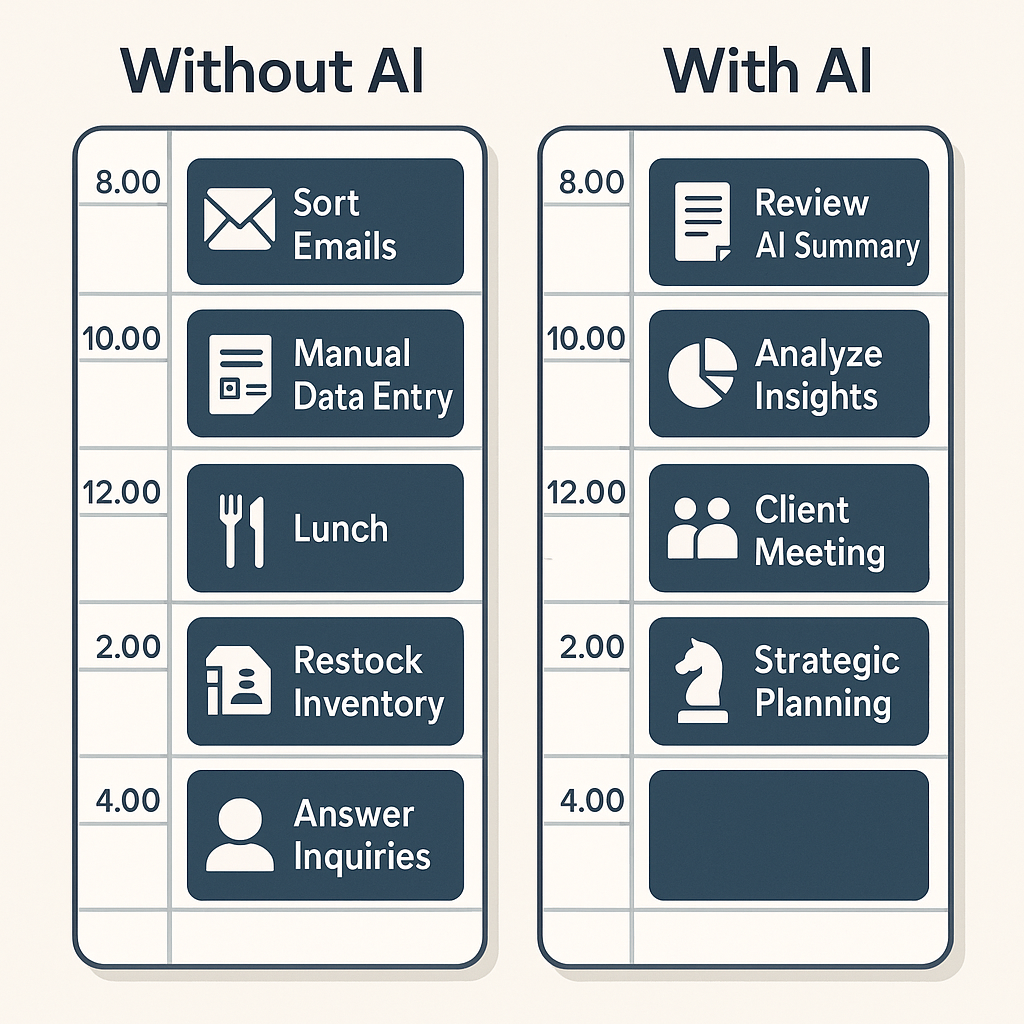
Automation isn’t about removing the human. It’s about reserving the human for when it really matters.
-
AI handles routine. "What’s your return policy?" → chatbot.
-
Humans handle nuance. "I got the wrong item, and it’s my kid’s birthday." → real support agent.
Ben trained his support team to step in with empathy when needed—and customer loyalty soared.
Think of AI as your receptionist, not your CEO. It opens the door, answers the basics, and brings you in when it counts.
Final Thought: Is AI Worth It for Small Businesses?
Absolutely. If you’re the kind of owner who always says, “I just need more time”—AI is how you get it.
At Clearnet Marketing, we help entrepreneurs install automation systems that handle the grunt work—so they can focus on growth, not grind.
You’re already doing the hard part. Let us help you make it easier.
#BusinessAutomation #TimeBackTools #ScaleWithoutStress
Learn How Clearnet Marketing Can Set Your Business Up for Efficienty
©2025 Clearnet Marketing
Call Our Live Voice Ai Agent
+1 833-658-5774
Or Try our Live Voice Ai Chat Agent Right Here on our site -->