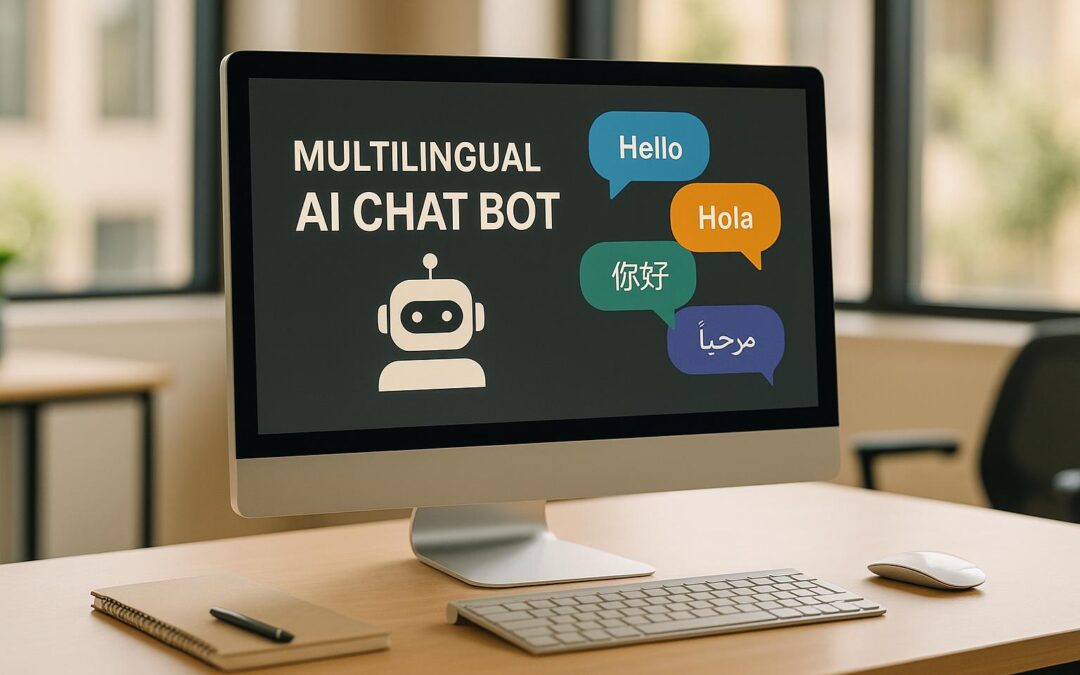
Short answer: A multilingual AI chatbot is conversational AI that engages, qualifies, and books leads in their preferred language — most often Spanish and English — automatically and around the clock. For local service businesses, it captures the substantial share of customers who would rather do business in Spanish and quietly leave when a website or phone line only works in English.
A homeowner in your area needs the exact service you sell. She finds your website, opens the chat, and types her question in Spanish. Your chat widget answers in English, or doesn’t understand, or hands her a form she half-fills and abandons. She closes the tab and messages the next business — the one that answered her the way she asked.
You never saw that exchange. It didn’t show up as a lost lead, because from your side, nothing happened at all. That is the quiet cost of running an English-only front door in a market that isn’t English-only.
This Is a Bigger Market Than Most Owners Realize
This is not a niche. It is one of the largest customer segments in the country, and in some regions it is close to the majority.
As of the 2024 American Community Survey, about 44.9 million people in the US age 5 and older speak Spanish at home — roughly one in every seven people. More than half of them live in California, Texas, or Florida. And the concentration in some metros is striking: in the Miami–Fort Lauderdale–West Palm Beach area, about 2.5 million residents — 42.7% of the population — speak Spanish at home.
If you run a service business in Florida, Texas, Arizona, California, or any growing metro across the Southwest and Southeast, a meaningful slice of the people searching for what you offer would rather start the conversation in Spanish. Many are fully bilingual and could manage in English — but “could manage” and “chose you” are not the same thing. People reach out to the business that meets them where they are.
When your only point of entry works in one language, you are not serving a smaller market on purpose. You are losing part of your real market by accident.
Why “We’ll Just Have Someone Translate” Doesn’t Solve It
Most owners, when they notice this gap, reach for a human fix. It runs into the same wall every time.
Hiring a bilingual receptionist helps — during the hours that person is at the desk, awake, and not already on another call or with a customer. It does nothing for the inquiry that comes in at 9pm, on a Sunday, or while they’re handling someone else.
Using a translation app mid-conversation slows everything down and makes the exchange feel clumsy at exactly the moment a prospect is deciding whether you’re the kind of business that has its act together.
And a generic website translation plugin converts your page — it does not have a conversation. It can’t answer a question, qualify the lead, or book the appointment. The customer still hits a dead end the moment they want to actually do business.
The problem was never a lack of goodwill. It’s that responding to every inquiry, in the right language, at the moment it arrives, is not something a person can do consistently. A system can.
What a Multilingual AI Chatbot Actually Does
Quick Answer: A multilingual AI chatbot detects the language a customer is using and responds naturally in that language — handling the full conversation, not just translating a page. It answers questions, asks the right qualifying questions, and books the appointment directly into your calendar, in Spanish or English, at any hour. The same capability extends to voice, so a caller can be greeted and booked in their own language too.
The mechanism is straightforward. A visitor opens your chat — or calls your line — and the conversational AI recognizes the language they’re using and continues in it. From there it does the work a good front-desk person would: understands what they need, asks what matters for your business, offers real availability, and books them. The booking lands in your calendar and the interaction is logged, whether the conversation happened in English at 2pm or in Spanish at midnight.
Why Does Answering in Someone’s Own Language Win the Booking?
Because the first response sets the tone for the entire relationship. A prospect who gets a clear, immediate answer in the language they reached out in feels understood — and feeling understood is what builds enough trust to book. It is the same speed-to-lead principle that decides every service inquiry, with an extra layer: you’re not only first to respond, you’re the one who responded in a way that signals this business is for me. That impression forms before anyone has met you.
Is This Just for Spanish?
Spanish is where the opportunity is largest for most US service businesses, which is why it’s the obvious place to start. But multilingual conversational AI isn’t limited to two languages — it can engage in whichever languages show up in your market. The point isn’t to chase every language. It’s to stop losing the customers who are already in your area, already searching for your service, and already trying to reach you.
Proof You Can Check Yourself
We don’t ask you to take a results claim on faith — and you won’t find invented client numbers here, because that’s not how Clearnet builds trust. Here’s a better kind of proof: the Voice AI on Clearnet’s own line is live right now, and it doesn’t need you to speak English to it. Call it, talk to it the way one of your customers would, and hear how a multilingual system actually handles a real conversation. We run it on our own business before we build it for anyone else’s.
This is one of three pillars in the system Clearnet builds for local service businesses: Conversational AI that engages and books leads across chat and web, a Voice AI receptionist that answers every call, and Follow-Up Automation that keeps working a lead across text and email until they book. Multilingual capability runs through all three — because a lead who reaches you in Spanish should be followed up with in Spanish too.
What Staying English-Only Keeps Costing
Every week, customers in your market open your chat or dial your number expecting to do business in their language — and quietly move on when they can’t. You don’t feel it, because the loss is invisible from where you sit. There’s no missed-call log for a website chat someone abandoned in silence.
Meanwhile, the competitor who set up a multilingual front door is booking those same people. Not because their service is better than yours. Because their door opened and yours didn’t.
The version where this is fixed is simple to picture: a prospect reaches out in whatever language is comfortable, gets an immediate and natural response, and is booked before they’ve thought to check anyone else. Your calendar fills with customers your old setup would have lost without a trace.
See What Your Market Is Actually Asking For
If your business sits in a region with a significant Spanish-speaking population — and most US metros now do — there’s a straightforward question worth answering: how many of the people trying to reach you are doing it in a language your current system can’t handle? A diagnostic call will map exactly that, along with where those leads are slipping away and what a multilingual system would look like built around your business.
Book a diagnostic call at clearnetmarketing.ai. And before you do, call our line and try it in Spanish — it’s the fastest way to understand what we mean.
Frequently Asked Questions
What is a multilingual AI chatbot?
A multilingual AI chatbot is conversational AI that detects the language a customer is using and responds naturally in that language — most commonly Spanish and English. Unlike a translation plugin, it holds a real conversation: it answers questions, qualifies the lead, and books the appointment directly into your calendar, at any hour and in the customer’s own language.
Why does a local business need a multilingual chatbot?
Because a large share of US customers prefer to do business in Spanish — about one in seven people speak it at home, concentrated heavily in Florida, Texas, California, and the Southwest. An English-only chat or phone line quietly loses those prospects to competitors who answer them in their language. A multilingual chatbot captures leads your current setup never records as lost.
How is this different from translating my website?
A website translation plugin converts the words on your page but can’t have a conversation, answer a question, qualify a lead, or book an appointment. A multilingual AI chatbot does all of that in the customer’s language, turning a passive translated page into an active booking system that works around the clock.
Can the AI handle phone calls in Spanish too, not just chat?
Yes. The same multilingual capability extends to voice. A Voice AI receptionist can greet a caller, understand their request, qualify them, and book the appointment in Spanish or English. You can hear this directly — Clearnet’s own line runs a live multilingual Voice AI you’re welcome to call and test.
How much does a multilingual AI chatbot cost?
Investment depends on your market, the languages you need, your call and chat volume, and how much of your booking and follow-up you want automated. Clearnet scopes this on a diagnostic call rather than listing a fixed price, because a system built around your actual business and region looks different from a generic plug-in. Book a diagnostic call at clearnetmarketing.ai for a tailored assessment.