[DIRECT ANSWER] AI automation for high-ticket businesses eliminates the four revenue leaks that manual operations cannot solve: slow lead response, inconsistent follow-up, appointment no-shows, and dormant prospects that never get re-engaged. A properly built system responds to new leads in under 90 seconds, follows up across five to seven touchpoints automatically, and runs continuously — so premium service businesses in real estate, home services, legal, medical, hospitality, and consulting capture the revenue their competitors are leaving on the table.
TLDR for busy owners: Every high-ticket service business has the same four revenue leaks — slow lead response, inconsistent follow-up, appointment no-shows, and a backend that was never built to scale. This guide maps each one, explains what a properly built AI system does to close them, and shows exactly what that looks like across six premium industries. If you recognize your business in these pages, the next step is a private strategy call at clearnetmarketing.ai.
Table of Contents
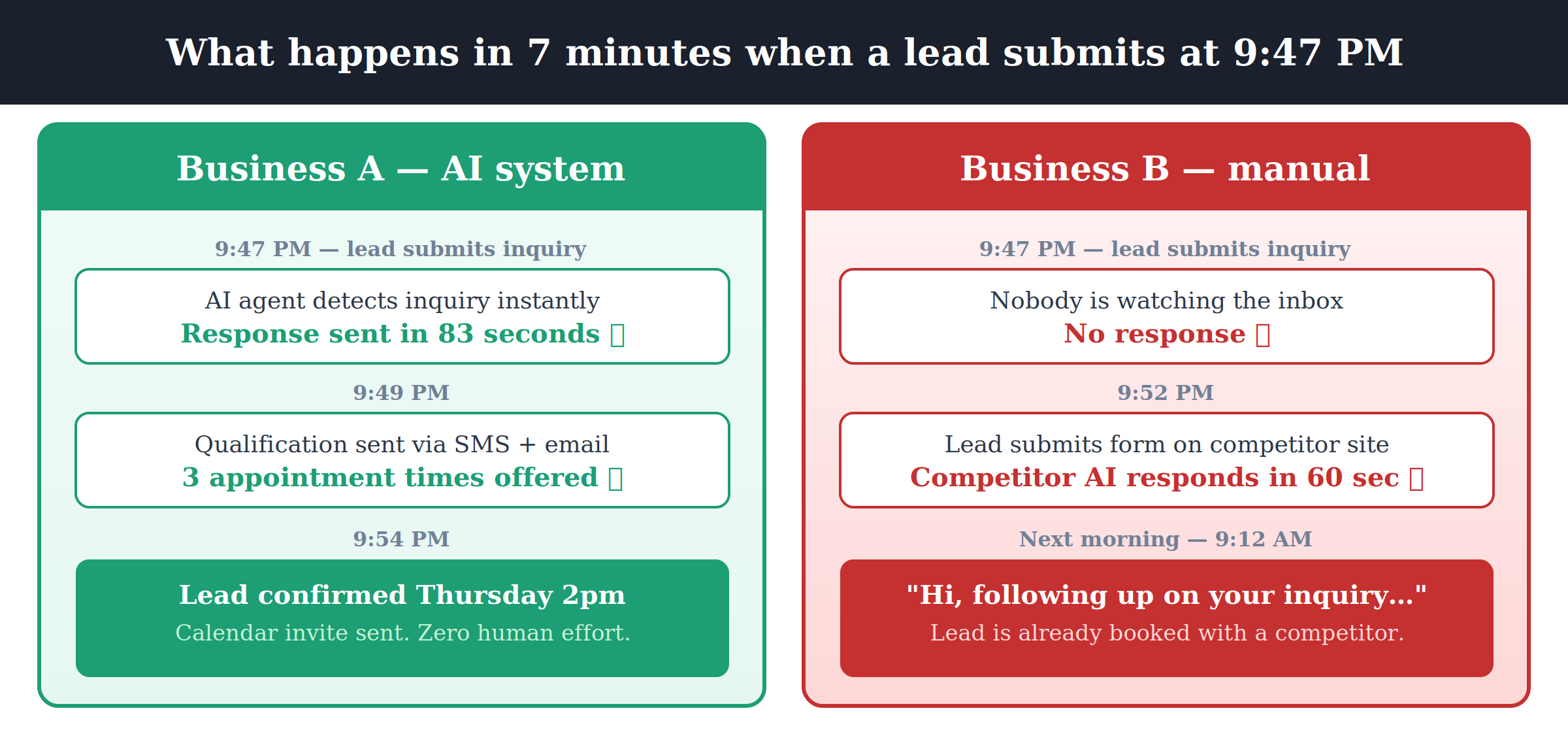
It is 9:47 on a Wednesday night. A homeowner in your market just submitted a form on your website asking about your highest-margin service. Your office is closed. Your phone is off. No one answers.
By 9:52, she has submitted the same form on a competitor's site.
By 9:54, that competitor's AI system has already responded with her name, confirmed her request, and offered her three appointment times.
By Thursday morning, she is booked. You will never know she existed.
This is not a hypothetical. This is the structure of modern lead loss — quiet, invisible, and compounding. The businesses that understand this are building systems to close the gap. The ones that don't are competing harder for leads they are increasingly less likely to win.
This guide is for the owners and operators of high-ticket service businesses who are excellent at what they do and are losing revenue they cannot see to a backend that was never designed to scale. It covers what AI automation actually is in a service business context, what it does for each of the six verticals where it produces the highest return, and what a properly built system looks like from the inside.
What "AI automation" actually means for a service business
The term gets used loosely. For a high-ticket service business, it means something specific and immediately valuable.
Quick Answer: AI automation for a service business is the elimination of every revenue-critical task that currently depends on a human remembering to do it — lead response, follow-up sequences, appointment confirmations, intake qualification, re-engagement campaigns, and CRM updates. It does not replace your team. It removes the category of failure that no amount of good intentions can prevent: the human limit.
The case for automation is not about reducing headcount. It is about removing the failure mode that no amount of good intentions can fully prevent. Humans get busy, distracted, and inconsistent. A system does not.
Research published by the MIT Lead Response Management Study found that the probability of contacting a new lead drops by over 1,000 percent after the first hour. At five minutes, a business is roughly 100 times more likely to reach that lead than at 30 minutes. Most high-ticket service businesses are responding in four to seven hours — if they respond at all.
The math on that gap is not complicated. If your average client value is $10,000 and you are losing two qualified leads per week to slow response, you are leaving over $1 million in annual revenue on the table — not because your service is inferior, but because your system is slower than your competitor's.
That is the problem AI automation solves. Not theoretically. Structurally.
The four revenue leaks every high-ticket business shares
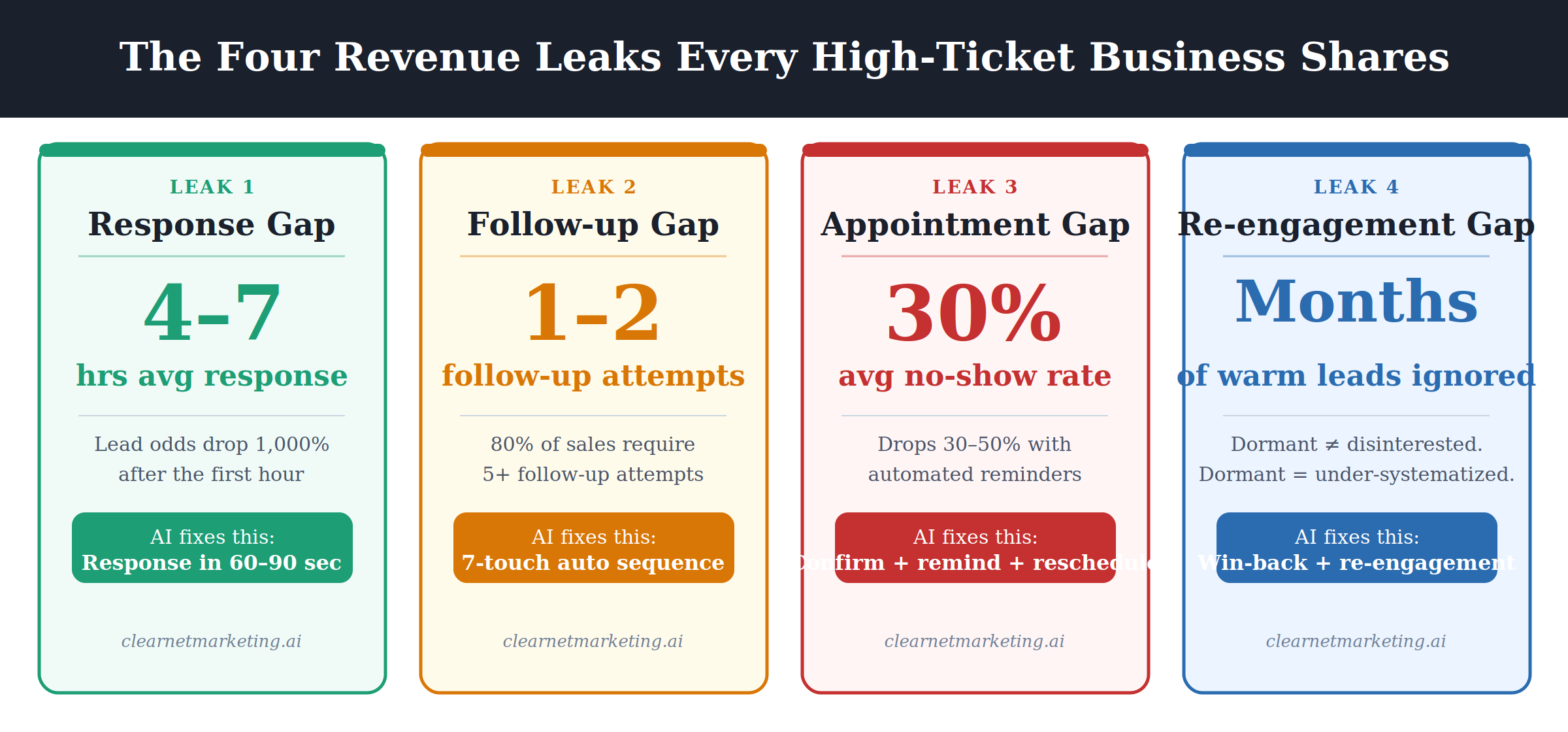
Before getting to the vertical-specific applications, it helps to name the universal failure points. The same four gaps appear in almost every service business we audit, regardless of industry.
Leak 1: The response gap. A lead comes in through the website, a social DM, a referral form, or a missed call. The response takes hours. The lead goes cold or books elsewhere. Most businesses have no visibility into how often this happens.
Leak 2: The follow-up gap. A lead is contacted once, maybe twice. Then it is mentally filed under "not interested" and never pursued again. Research from the National Sales Executive Association indicates that 80 percent of closed sales require five or more follow-up attempts. Most businesses stop after two.
Leak 3: The appointment gap. A prospect books a call or consultation. They do not receive a confirmation. They do not receive a reminder. They show up late, reschedule at the last minute, or do not show up at all. No-show rates for businesses without automated confirmation and reminder sequences range from 15 to 30 percent.
Leak 4: The re-engagement gap. A lead goes warm, goes cold, and is never contacted again. A past client has not returned. A webinar attendee never booked. A pipeline contact has been sitting in "nurture" status for four months with no activity. These are qualified prospects who expressed interest and were simply never followed up with consistently enough to convert.
A properly built AI system closes all four gaps simultaneously — not by working harder, but by working without stopping.
[INTERNAL LINK: how missed calls cost home service businesses]
How it applies across six high-ticket industries
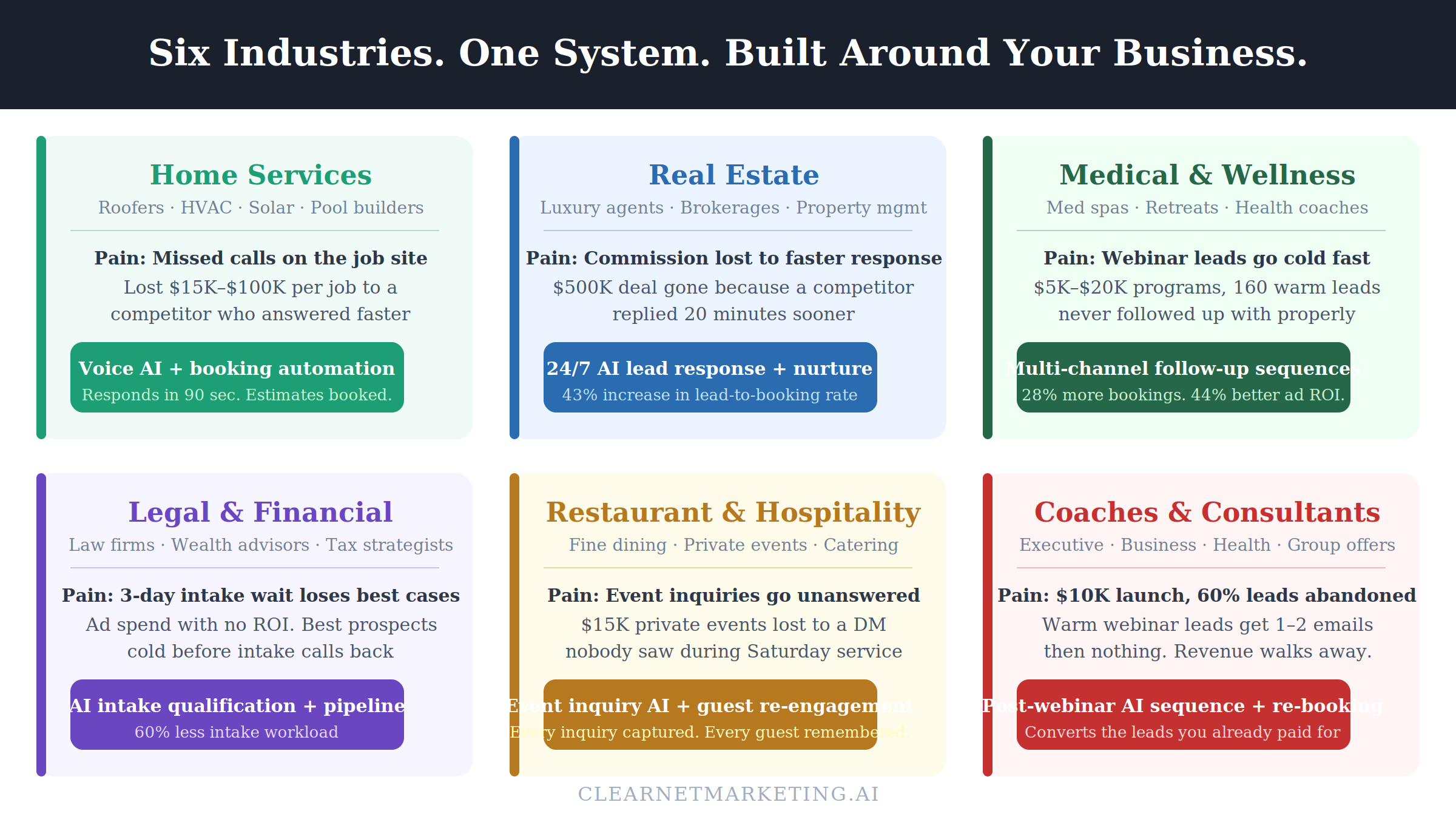
Home services — premium contractors, roofers, builders, HVAC, solar
The home services business owner is uniquely exposed to the response gap. They are on a job site, not at a desk. Every call that goes unanswered during business hours is a lead that has already started calling the next contractor on their list.
The compounding problem is that home services businesses often compete on quality and reputation — which means they lose deals on speed before their quality ever gets the chance to matter.
Consider the scale of this problem directly: if your average job is $15,000 and you miss three qualified leads per week, the potential revenue gap is $45,000 weekly. Even a conservative conversion rate applied to that number reveals annual losses that would be considered catastrophic if they showed up on a balance sheet. They never do — because lost leads don't show up anywhere.
The AI automation stack for home services centers on three systems. A voice AI agent that answers every inbound call, captures lead details, qualifies the prospect, and books an estimate appointment directly to the owner's calendar. A multi-channel follow-up sequence — text, email, and voicemail drop — that pursues every lead across five to seven touchpoints over the first seven days. And a confirmation and reminder sequence that reduces no-shows before estimate appointments and keeps the pipeline moving without manual effort.
The result is a business that competes on speed without sacrificing service quality — because by the time the owner shows up to the estimate, the prospect has already been engaged three times and has a high level of trust in the professionalism of the operation.
[INTERNAL LINK: how missed calls cost home service businesses]
Real estate and property management
Real estate is the industry where the cost of slow response is most immediately quantifiable. A commission lost to a competitor does not disappear because of a better marketing strategy. It disappears because a competitor responded 20 minutes faster to a 10pm inquiry.
The standard response to this problem — hire more staff, add an ISA, build a follow-up team — does not solve the speed problem. It adds capacity at the cost of margin. What solves the speed problem is a system that responds in under 90 seconds, regardless of the hour.
In practice, the results are significant. A real estate team we built a system for — an agent in Scottsdale who was losing leads after business hours with inconsistent follow-up — saw a 43 percent increase in their lead-to-booking rate after implementing AI-powered lead capture and calendar automation. They recovered more than five hours per week that had previously gone to manual follow-up tasks, and attributed over $2.1 million in closed revenue directly to leads captured and nurtured by the AI system.
That is not an outlier. That is what happens when a high-performing agent stops competing on availability against a system that never goes offline.
For real estate and property management, the highest-leverage AI applications are lead response and qualification for inbound inquiries from all sources — listing portals, website forms, social platforms, and missed calls. AI-driven nurture sequences for leads who are not ready to transact now. Automated appointment booking for showings and listing presentations. And for property managers, a dedicated tenant communication and maintenance request workflow that handles volume without adding headcount.
[INTERNAL LINK: real estate AI follow-up system]
Medical and wellness — med spas, wellness retreats, high-ticket health programs
Medical and wellness businesses spend heavily on marketing — ads, content, webinars, events — to attract qualified prospects. The tragedy of most wellness businesses is not that the marketing fails. It is that the follow-up gap turns expensive leads into dead ones.
Consider the math on a webinar-driven wellness retreat. An operator spends $5,000 on a webinar that attracts 200 attendees. Forty book a discovery call. Fifteen enroll. The 160 who attended but never booked a call receive two generic follow-up emails and are never contacted again. On a $5,000 program, the revenue lost from those 160 warm attendees — people who gave up an evening to attend — is not a marketing problem. It is a systems problem.
We built a multi-channel follow-up system for a wellness retreat brand dealing with exactly this pattern — low follow-through after discovery calls and webinars. The result: a 28 percent increase in completed bookings, a 44 percent increase in ad spend ROI, and email open rates above 90 percent using personalized AI sequences. The leads were already there. The system simply stopped letting them go cold.
The AI automation stack for medical and wellness businesses prioritizes structured multi-channel follow-up that contacts webinar attendees and discovery call inquiries across email, SMS, and voice — personalized by how far they progressed in the funnel. An automated booking and confirmation system that reduces no-shows. And a re-engagement campaign that brings past clients and warm leads back through timely, contextually relevant outreach.
There is also a positioning benefit here that goes beyond the numbers. A med spa or retreat brand that delivers a polished, personalized automated experience from the first inquiry communicates something powerful about the standard of care the client can expect inside the service itself. The intake experience is the first impression. It should match the quality of everything that follows it.
Legal and financial — law firms, wealth advisors, tax strategists, financial coaches
Legal and financial businesses share a unique reluctance about automation — one that is understandable, because their clients value trust and discretion above nearly everything else. The perceived risk is that automation will make the firm feel impersonal or transactional.
That perception gets the causality backward.
The intake process for most law firms and financial practices is already impersonal — it is just impersonal in a way that reflects disorganization rather than automation. Leads wait three days for a callback. Inquiries are screened by whoever happens to be available. Prospects fall out of the pipeline because no one tracked where they were in the qualification process.
We built an AI-powered chat and voice intake system for a boutique personal injury law firm that was drowning in unqualified leads while their actual best prospects went cold during the intake wait. After implementing pre-qualification logic and intelligent routing, they reduced intake workload by 60 percent, improved the quality of cases reaching their attorneys, and cut case onboarding time by three days. The attorneys stopped spending their time screening calls that should never have reached them — and started spending it on the cases that mattered.
A prospect who inquires about estate planning or wealth management at 11pm on a Sunday and receives a professional, informed response within 90 seconds does not think "this is a chatbot." They think "this firm has their act together." That distinction is the difference between a trust problem and a trust asset.
[INTERNAL LINK: AI intake automation for law firms]
Restaurant and hospitality — fine dining, private events, upscale catering, multi-location operators
The restaurant and hospitality business faces a specific challenge: the highest-value revenue opportunities — private dining events, buyouts, catering engagements — are almost always lost not in the room, but in the inbox.
A fine dining venue that generates $15,000 on a private event can lose that event to an unanswered DM on a Saturday afternoon. An upscale caterer can lose an entire season's worth of inquiry leads because the event coordinator is managing Saturday service and the inquiry form sits unread until Monday.
The AI automation stack for restaurant and hospitality centers on two systems. A 24/7 inquiry response and qualification agent for private event and catering requests — one that captures event date, guest count, budget range, and contact information and immediately moves the prospect toward a follow-up consultation. And a reservation confirmation, reminder, and re-engagement system that reduces no-shows, recovers lapsed reservations, and re-activates past guests through personalized outreach.
The re-engagement system is consistently the one that surprises hospitality operators most. A guest who dined six months ago and has not returned is not a lost client. They are a dormant one. A well-timed, personalized message — tied to a seasonal menu, an upcoming event, or simply a genuine invitation to return — converts at rates that justify the automation investment on its own.
[INTERNAL LINK: restaurant AI automation]
Coaches and consultants — executive coaching, business consulting, high-ticket group programs
High-ticket coaches and consultants invest disproportionately in launches — webinars, challenges, live events, content campaigns — and often experience disproportionate disappointment when the conversions do not match the investment. The culprit, almost universally, is the follow-up gap.
Most coaches follow up once or twice after a webinar. A generic email. A reminder to book a call. Then nothing. The leads who were warm but not ready — who needed three more touchpoints before committing — fall out of the funnel and into a competitor's sequence.
The AI automation stack for coaches and consultants begins with a post-webinar follow-up sequence that operates across email, SMS, and personalized voice message — differentiated by the prospect's level of engagement during the event. A booking automation that reduces the friction between expressing interest and scheduling a discovery call. A no-show recovery system that automatically re-engages and reschedules missed calls. And a re-engagement campaign that works the warm list built over months or years of launches — prospects who were interested at some point and were simply never followed up with systematically.
When the follow-up is automated and consistent, the coach is no longer dependent on a perfect launch or a massive list to generate qualified calls. The system nurtures the existing audience continuously — making every list more valuable than it appears on the surface.
What results look like in practice {#results}
The patterns across these verticals are consistent enough to describe with specificity.
A real estate agent running on manual follow-up — responding to leads when they get around to it, using a spreadsheet as a CRM, missing calls after hours — is leaving a significant percentage of their potential revenue uncaptured. The businesses we build systems for routinely see lead-to-booking rates increase by 30 to 50 percent within the first 90 days, not because the leads improved, but because the follow-up finally matched the quality of the inquiry.
In legal and medical practices, the most immediate impact is on intake efficiency. When AI pre-qualifies leads before a human enters the conversation, the attorneys and practitioners who were spending two to three hours a day on screening calls get that time back — and the quality of their booked consultations improves simultaneously.
For wellness and coaching businesses with webinar-driven funnels, the math is particularly clear. Every warm lead that was generated by a launch and then dropped after two emails is recoverable revenue sitting in a cold database. A structured re-engagement sequence run against that database typically produces booked calls within the first week — from leads the business had written off months ago.
The throughline: the revenue was always there. The system just was not built to capture it.
How a fully built system is structured
The six vertical applications above all rely on the same foundational infrastructure, configured differently for each business context. Here is how a complete system is built, layer by layer.
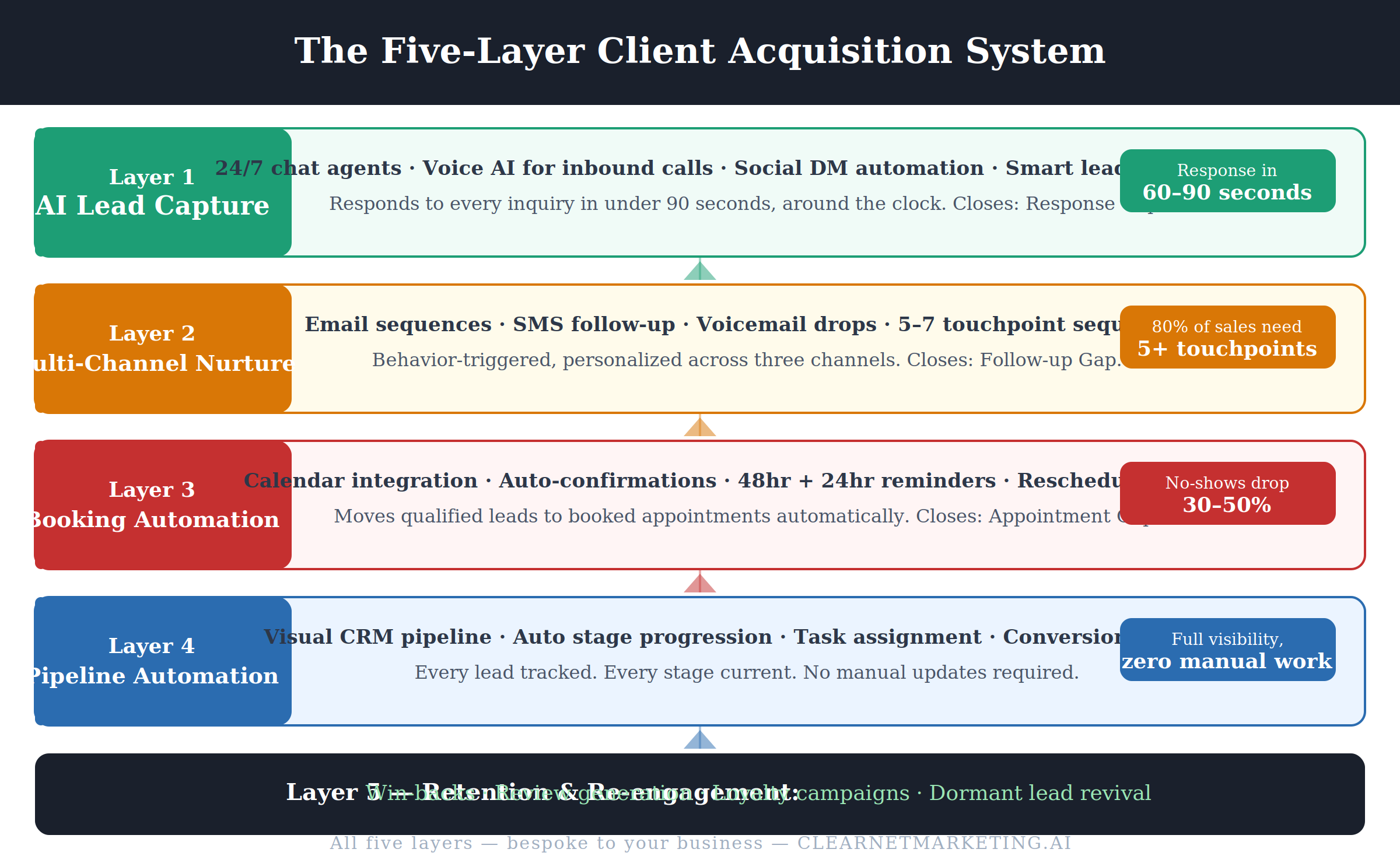
Step 1 — Build the AI lead capture layer. A conversational agent deployed across the website, landing pages, and social platforms — capturing, engaging, and qualifying every inquiry in real time, 24/7. Combined with a voice AI agent for inbound calls, this layer eliminates the response gap entirely. Every lead gets a response in under 90 seconds, at any hour.
Step 2 — Build the multi-channel nurture sequences. Email, SMS, and voicemail drop sequences triggered by lead behavior — prospect submits a form, watches a webinar, clicks a link, or goes quiet after initial engagement. Each sequence is personalized to the prospect's context and designed to generate action across five to seven touchpoints, not one or two.
Step 3 — Build the booking and calendar automation. Integrated scheduling that moves a qualified lead directly from AI conversation to confirmed appointment — with automatic confirmations, reminders at 48 hours and 24 hours, and a rescheduling flow that recovers near-misses before they become lost opportunities.
Step 4 — Build the CRM pipeline automation. A visual pipeline with automated stage progression, task assignment, and performance tracking — so the owner and team always know exactly where every lead is and what the next step is, without manually updating anything.
Step 5 — Build the retention and re-engagement layer. The layer most businesses neglect: automated campaigns that bring past clients back, generate reviews, recover lapsed subscribers, and keep the warm list working continuously between active marketing campaigns.
Quick Answer: A fully built AI automation system for a high-ticket service business operates across five integrated layers — lead capture, multi-channel nurture, booking automation, CRM pipeline management, and retention/re-engagement — all configured to work together around the specific sales process and client journey of that business. Each layer closes a specific revenue leak. Together, they eliminate the manual dependencies that allow revenue to escape unnoticed.
The difference between businesses that get results from automation and businesses that don't is not the sophistication of the technology. It is whether the system is built as a coherent whole — designed around the specific sales process, client journey, and business model of the company it serves — or assembled from disconnected tools that were never designed to work together.
[INTERNAL LINK: CRM pipeline automation for service businesses]
The cost of waiting
There is a pattern we observe consistently across every industry and business type: the owners who are most skeptical of AI automation are the ones who are most actively losing to competitors who have already adopted it.
The competitive dynamics of 2026 favor the business that responds first, follows up most consistently, and delivers the most polished client experience from the first point of contact. None of those advantages require a larger team. They require a better system.
Every week without a system like this is another week of invisible losses — leads you didn't know you had, follow-ups that never happened, clients who felt forgotten and went somewhere else. The damage does not show up in any report. It accumulates quietly, until the businesses that built their systems first have a structural advantage that becomes very difficult to close.
The window to move first in your market is not permanently open. The businesses in your space that build these systems this year will have a compounding advantage that grows with every month they operate. The ones that wait will spend the next two years attempting to catch up.
The next step
If this guide described your business — or the version of your business you are still running on manual processes — the most useful thing you can do next is have a direct conversation about what a system built for your specific situation would look like.
Clearnet Marketing builds bespoke AI client acquisition and retention systems for premium service businesses across all six verticals covered in this guide. Every engagement begins with a private strategy call in which we map exactly where your current process is leaking revenue and what a purpose-built system would address, step by step.
There is no obligation. There is no pitch before the diagnosis. There is just clarity — and most business owners leave that conversation with a sharper picture of their own operation than they had when they arrived.
Book your Private Strategy Call at clearnetmarketing.ai.
The conversation starts there. The system gets built from there. The revenue it recovers tends to pay for everything else.
Clearnet Marketing builds AI-powered client acquisition and retention systems for high-ticket service businesses. Every client receives a dedicated success manager, a bespoke system engineered around their business, and ongoing strategic support. To learn how AI automation applies to your specific vertical, explore the related guides below or book your Private Strategy Call at clearnetmarketing.ai.
Frequently Asked Questions
Can we answer any more questions for you?
What is AI automation for high-ticket service businesses?
AI automation for high-ticket service businesses is the deployment of intelligent systems that handle revenue-critical tasks without human intervention — responding to leads within seconds, following up across multiple channels, confirming and reminding before appointments, and re-engaging dormant prospects. It removes the four primary revenue leaks that manual operations cannot reliably close: slow response, inconsistent follow-up, no-shows, and dormant leads.
How quickly does an AI system respond to new leads?
A properly built AI lead capture system responds to new inquiries within 60 to 90 seconds, regardless of time of day or day of week. This matters because research from the MIT Lead Response Management Study found that the probability of contacting a lead drops by over 1,000 percent in the first hour after inquiry. At five minutes, a business is roughly 100 times more likely to convert that lead than at 30 minutes.
Does AI automation work for businesses that rely on trust and personal relationships like law firms or financial advisors?
Yes and in these industries, a well-built AI system often strengthens rather than undermines trust. A prospect who inquires at 11pm and receives a professional, personalized response within 90 seconds does not experience that as impersonal. They experience it as organized and attentive. The AI handles intake qualification and initial engagement; the human professional handles the relationship from a position of context and confidence.
Your Title Goes Here
Clearnet Marketing is not a software company or a tool vendor. We are a systems partner — we build, configure, launch, and optimize bespoke automation systems engineered around each client's specific business, sales process, and client journey. Every client receives a dedicated success manager and a system built from scratch, not an off-the-shelf template. The technology serves the strategy, not the other way around.
What industries does Clearnet Marketing build AI automation systems for?
Clearnet Marketing specializes in six high-ticket verticals: home services (premium contractors, roofers, HVAC, solar), real estate and property management, medical and wellness (med spas, retreats, high-ticket health), legal and financial services (law firms, wealth advisors, tax strategists), restaurant and hospitality (fine dining, private events, catering), and coaches and consultants. All verticals share the same core revenue leak structure the solutions are configured differently for each.
How do I know if my business is ready for AI automation?
If your business is generating qualified leads and losing a measurable percentage of them to slow response, inconsistent follow-up, or no-shows — and if you have tried to solve that with additional staff or generic tools without fully resolving it — your business is ready. The strategy call is the right place to start: we audit your current process, identify specifically where revenue is leaking, and map what a purpose-built system would look like for your situation.